
Help us validate new measures of alexithymia (ALI)
Feelpath is an all-in-one therapy platform, turning session conversations into clinical insights, starting with alexithymia. Help us validate our session-based digital psychometrics of alexithymia.
- Early alexithymia signals: session-based markers
- Visual profiles: see clients' emotion words, gaps, and changes over time
- Client-ready learning: gentle, clinician-approved psychoeducation you can share in-session
For PIs, labs, and individual clinicians working with alexithymia.



Note from the founder
Hello! My name is Nick. For years I lived with alexithymia without knowing the word for it.
Being largely unaware of my internal emotional experiences strained my interpersonal relationships, increased my depression and anxiety, and created hurdles to engaging in therapy.
When I learned that alexithymia is a modifiable trait, I worked with my therapist to start building Feelpath. Feelpath offers alexithymia detection for therapists and education for clients, so others like me could get the guidance and attention needed to strengthen their emotional awareness and communication skills.
We'd love your help in validating the alexithymia detection and education features.

Nick Venturino
Founder, Feelpath
What is Alexithymiaand why we're building the Alexithymia Language Index (ALI)
Alexithymia (difficulty identifying and describing emotions) is common: around 10% of the general population meet criteria for alexithymia, and estimates range from 50–85% among many autistic and ADHD populations.[1,2]
It is strongly linked to interpersonal distress, insecure attachment patterns, and developmental factors such as early language delays and a reduced sense of agency.[3]
The measurement gap
- Self-report scales can miss in-session behavior and short-term change.
- Few workflow-friendly measures capture alexithymia-related language in-session.
The Alexithymia Language Index (ALI) tests whether session-derived language measures can help close this gap.[4,5]
Core features of alexithymia
Hard to know what I'm feeling.
Feelings are present but vague or blurry.
Hard to put feelings into words.
Emotions are felt but not easily described.
Focus on facts more than inner life.
Attention goes to events, not inner reactions.
Body sensations and emotions blur together.
It is hard to tell physical cues from emotional states.
Selected references
- Population study of alexithymia prevalence and sociodemographic correlates in Finnish adults. PubMed.
- Adolescent community study reporting alexithymia prevalence and links to emotional and behavioral difficulties. PubMed.
- Recent work on alexithymia, attachment, and developmental factors such as early language delays and agency. BMC Psychiatry.
- General‑population study linking alexithymia with somatization and physical symptom burden. PubMed.
- Emerging digital and behavioral approaches to identifying alexithymia using language and interaction patterns. JMIR Mental Health.
Neurodivergences & Emotion Difficulties
Emotions show up differently across people and neurotypes. This table highlights a few commonly reported patterns of difficulty / strain across domains. When emotional awareness is harder (alexithymia), regulation, executive functioning, and social-emotional inference can get harder too—especially under stress.
| Profile | AlexithymiaLow emotional awareness | Emotion dysregulationDysregulation under stress | Social-emotional skill gaps†Difficulty with empathy & perspective-taking | Executive dysfunctionDifficulty with planning, initiation & follow-through |
|---|---|---|---|---|
| ADHD | ◐ | ● | ◐ | ● |
| Autism (ASD) | ● | ● | ◐ | ◐ |
| AuDHD | ● | ● | ◐ | ● |
| CEN* | ● | ● | ◐ | ◐ |
| HSP* | ◐ | ◐ | ◐ | ◐ |
| Trauma / CPTSD | ● | ● | ◐ | ◐ |
| Anxiety / Depression & Perfectionism | ◐ | ● | ◐ | ◐ |
Table notes: Cells with a corner marker in the table above contain cell-specific details. Hover to preview, or click/tap anywhere in the cell.
Research references
Selected peer-reviewed sources supporting the main patterns summarized in this table, including the idea that alexithymia (low emotional awareness) can cascade into harder regulation, social-emotional inference, and downstream functioning—especially under stress.
- Kinnaird, Stewart, & Tchanturia (2019): Investigating alexithymia in autism: A systematic review and meta-analysis
- Bird & Cook (2013): Mixed emotions: the contribution of alexithymia to the emotional symptoms of autism
- Craig et al. (2016): Executive functioning in children/adolescents with high-functioning autism: a meta-analysis
- Demetriou et al. (2020): Executive function in autistic adults: a meta-analysis
- Bora et al. (2013): Meta-analysis of neuropsychological tests in major depressive disorder (incl. executive function)
- Scott et al. (2015): A quantitative meta-analysis of neurocognitive functioning in posttraumatic stress disorder
- Trevisan et al. (2019): Interoceptive awareness and alexithymia: A meta-analysis distinguishing accuracy vs sensibility
- Laloyaux et al. (2015): Evidence of contrasting patterns for suppression vs reappraisal emotion regulation strategies in alexithymia
- Kiraz, Sertçelik, & Taycan (2021): Alexithymia and impulsiveness in adults with ADHD (primary study)
- Edel et al. (2010): Alexithymia, emotion processing, and social anxiety in adults with ADHD (primary study)
- Herpertz et al. (2024): Emotion processing difficulties in ADHD: a Bayesian meta-analysis
- Ditzer et al. (2023): Childhood maltreatment and adult alexithymia: a meta-analysis
- McDonald et al. (2024): Emotion dysregulation in autism: A meta-analysis
- Song et al. (2019): Empathy impairment in autism spectrum conditions from a multidimensional perspective: A meta-analysis
- Milton (2012): On the ontological status of autism: The “double empathy problem”
- Crompton et al. (2020): Neurotype-matching (not autistic status) influences ratings of interpersonal rapport
- Di Tella et al. (2024): On the relationship between alexithymia and social cognition: A systematic review
- Beheshti et al. (2020): Emotion dysregulation in adults with ADHD: a meta-analysis
- Edwards (2022): Posttraumatic stress and alexithymia: A meta-analysis of presentation and severity
- Khan & Jaffee (2022): Alexithymia in individuals maltreated as children and adolescents: a meta-analysis
- Somerville et al. (2024): Emotion controllability beliefs and young people’s anxiety and depression: A systematic review
- Acevedo et al. (2018): Sensory processing sensitivity brain circuits review
- Network-based meta-analysis of sensory processing sensitivity (2025): Relations with personality/temperament traits
† In this table, “difficulty reading emotion / empathy” refers to how easy it is to read cues and infer what someone might be feeling/meaning (emotion recognition and perspective-taking), not how much someone cares. This domain is also harder to measure and comparatively under-researched, so the notes are meant to add nuance and reduce overgeneralization.
* CEN (Childhood Emotional Neglect) is an experience; HSP (Highly Sensitive Person) is a temperament trait. They’re included because support needs often overlap with neurodivergent profiles.
How Feelpath works
Feelpath is a video platform for telehealth therapy sessions, suitable for clinical and research use.
Join your session

00:12 · Client: I just felt off but could not say what.
03:47 · Client: Weekend was fine. I do not really know what I felt.
Session Transcript
Stay close to what was actually said
Session language is captured as a transcript that can be searched, highlighted, and revisited together.
Transcript highlights
Client: I just felt off but could not say why.
Therapist: When you say off, what do you notice in your body?
Client: Weekend was fine. I do not really know what I felt.
Highlighted language
Alexithymia Scales:
TAS vs PAQ vs ALI
A quick, high-level comparison of the widely used self-report scales VS. our conversation-derived ALI approach.
TAS-20
Toronto Alexithymia Scale
- 20-item self-report checklist.
- Global alexithymia score plus three subscales.
- Widely used benchmark in research.
PAQ-24
Perth Alexithymia Questionnaire
- Self-report with positive and negative emotion subscale scores.
- Richer profile of identifying and describing feelings.
- Still relies on people rating themselves on items.
ALI
Alexithymia Language Index (Feelpath)
- Conversation-derived indices from session language.
- Component-aligned scores tied to concrete, labeled excerpts.
- Designed to complement TAS/PAQ, not replace them.
Example composite scores show alexithymia indices trending down from last month to this month across six score dimensions.
Insightful analytics
Analytics that make alexithymia easier to see
Our example analytics panel shows how language patterns can be summarized into clear signals for identifying, describing, and relating to feelings.
Client psychoeducation
Personalized psychoeducation based on session conversation
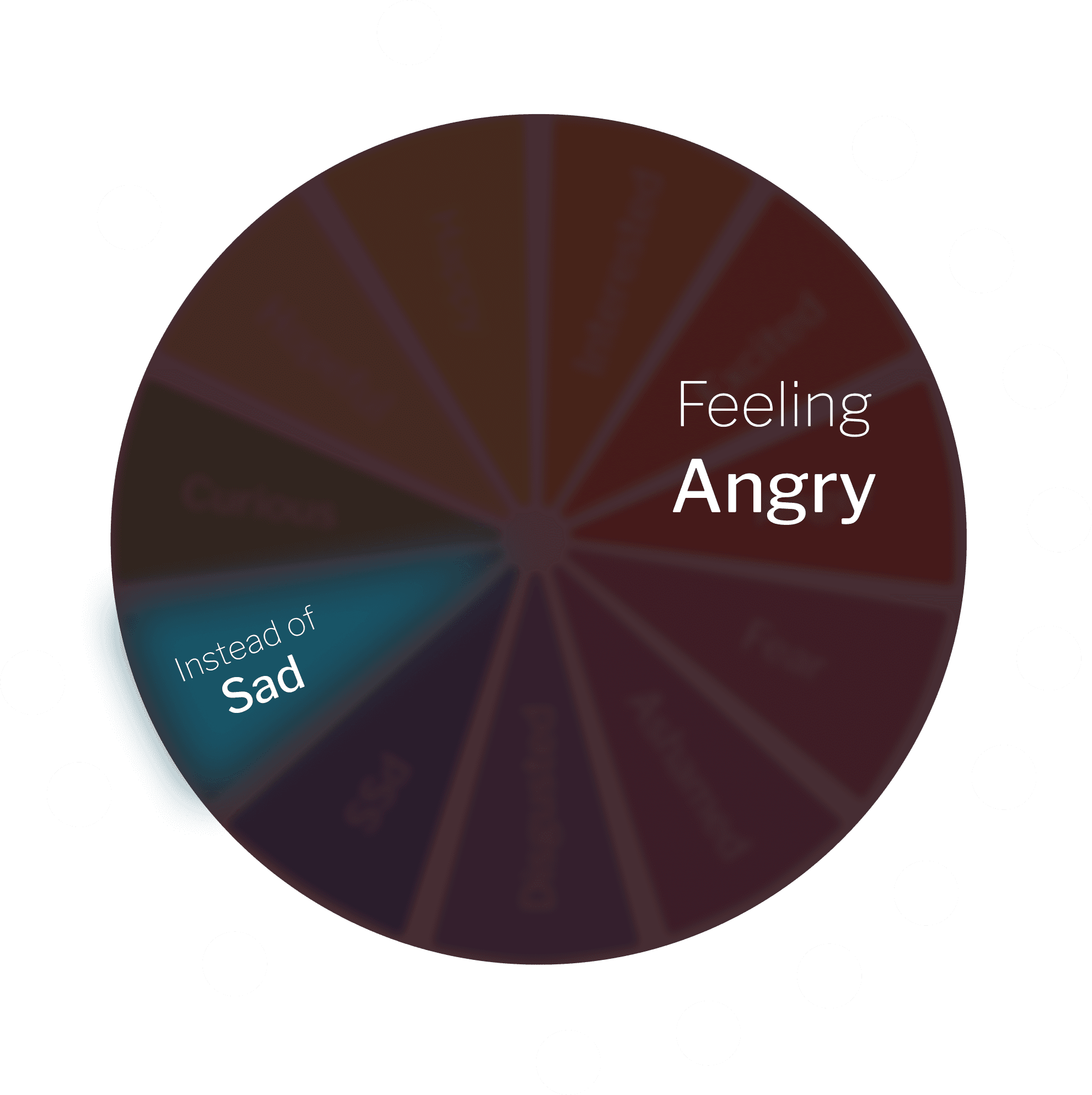
We offer clients additional support outside of the session through personalized psychoeducation tools like our smart emotion wheels, dynamically updated and created based on the session conversation.
Click different dots to see a visual explanation of what the client might be feeling underneath.
Feelpath as a research platform
We're building on top of a working HIPAA-focused platform, analytics, and clinician/client UIs so that labs can plug in their own study questions rather than starting from scratch.
Feature preview
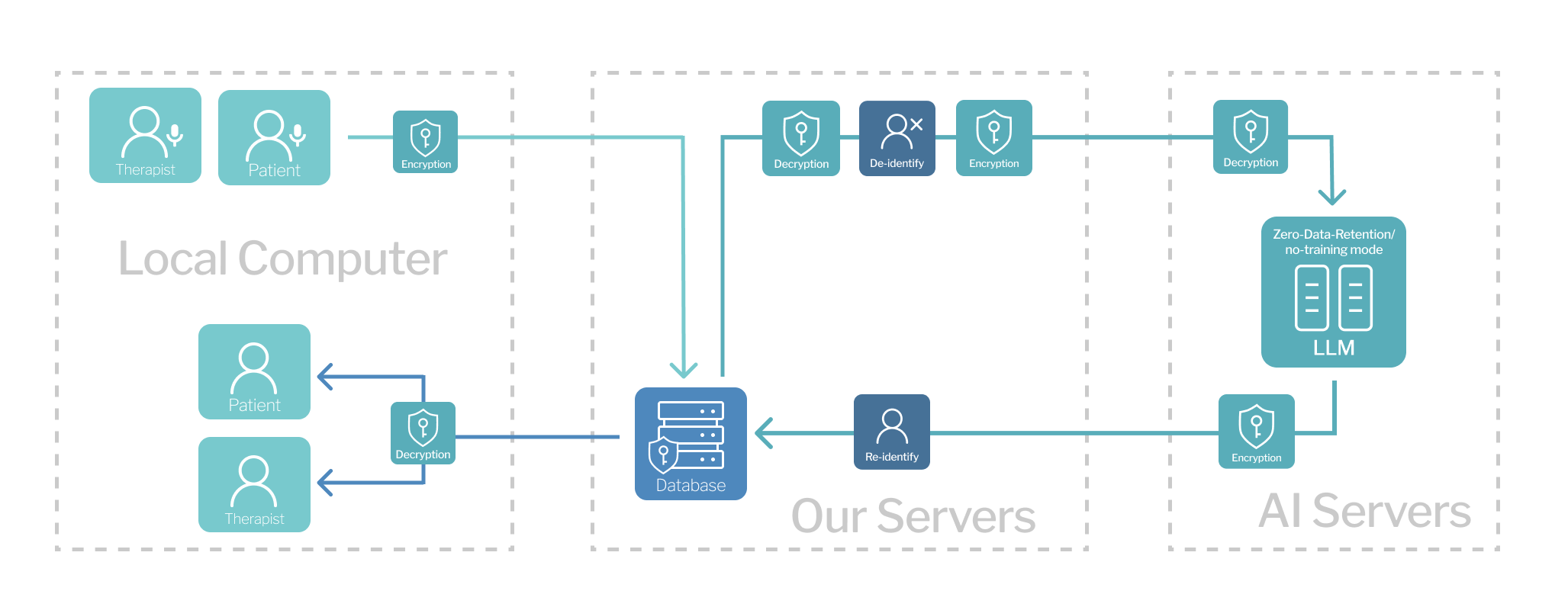
Study readiness examplesWorking platform & privacy safeguards
Example of how sessions move through encryption, de-identification, and analysis before results return to clinicians.
Clinical guardrails and intended use
A quick overview of how ALI is meant to be used today in research and clinical settings.
Not a diagnostic tool today
ALI surfaces candidate markers and indices to support research and clinical reflection. It is not intended to diagnose or prescribe treatment, and should not be used as a standalone decision-maker.
Clinician and supervisor in the loop
Outputs are designed to be read, questioned, and integrated by human clinicians and supervisors. The therapeutic relationship, case formulation, and clinical judgment stay central.
Not a crisis or triage system
ALI focuses on alexithymia-related patterns over time, not on real-time risk assessment or crisis services. It should be paired with your existing protocols for safety and escalation.
Trusted by people exploring their emotions
Real words from people using these tools to better understand their emotional life.
“The way I can use the computer to zero in on specific feelings is groundbreaking. I find this makes healing and growth more effective and powerful.”
Matt K.
Feelpath participant
“I love getting insights on how I've been expressing myself emotionally. I can't wait to see how the product develops to make me more aware and embodied as my emotional self.”
Jessica R.
Feelpath participant
“The emotion wheels, which highlight frequently used words in my transcripts, have been instrumental in increasing self-awareness and aiding reflection.”
Michael C.
Feelpath participant
“I deeply appreciate the emotion wheels, especially those focusing on positive self-regard and shame. Their insightful design helps me navigate complex emotions with clarity and understanding.”
Sarah T.
Feelpath participant
“I've found myself turning to these wheels more frequently, as they provide invaluable guidance in my journey of self-awareness and emotional exploration.”
Kristen V.
Feelpath participant
“Grateful for the profound impact this software has had on my understanding of myself and others.”
Robert M.
Feelpath participant
How we protect what people share
ALI is built on the same privacy protections as the rest of Feelpath: HIPAA-focused, consent-first, and designed so that individuals and clinicians can see and control how their information is used.
Consent-first design
Clear language about how session language is saved and analyzed, with controls to turn AI features on or off and to adjust retention and sharing.
BAAs + HIPAA-aligned safeguards
Encryption in transit and at rest, BAAs with clinicians, and logged access help support the kind of privacy expected in clinical and research settings.
Care for what people share
People share real, vulnerable things during therapy. At Feelpath, we take this seriously. We keep the words shared in session, and the insights built from them, private, protect them carefully, and keep them in service of the work of therapy.
Looking for validation and partnership
ALI is at the measurement and validation stage. Our goal is to build and test language-based measures of alexithymia with you.
Our Validation Goals
- Convergent validity with existing alexithymia and emotion measures.
- Reliability across sessions, contexts, and populations.
- Links to interpersonal distress, attachment patterns, and developmental factors like early language delays.
How You Can Help
- Embed ALI as an additional measurement channel in existing studies or programs.
- Co-design new protocols focused on alexithymia-related language and change over time.
- Help shape thresholds, reporting formats, and clinical wording.
Any diagnostic or regulatory path would be a separate, later stage with its own governance. Today, the focus is on careful measurement, validation, and fit with real clinical work.

In case you missed anything
A few of the questions research partners and clinicians most often ask about ALI. For more detail on privacy, data handling, and product usage, you can visit our full FAQ.
No. ALI is designed for research and clinical insight about alexithymia-related patterns in session language. It is not intended to diagnose at this stage and does not replace clinical judgment or therapy.
We are seeking PIs, labs, and individual clinicians who want to study alexithymia-related patterns in language, compare ALI-style indices with existing measures, and help shape how results are visualized and used in practice.
ALI is designed to sit alongside your existing therapy, research, and documentation workflows. With consent, session language is analyzed to produce indices, visuals, and psychoeducation prompts that you can review between or during sessions.
We are building a simple way to derive psychometric-style measures directly from therapy and research sessions, and to pair those measures with personalized psychoeducation for clients who struggle with alexithymia-related traits.
Academic labs and individual clinicians or therapists who are interested in digital language-based measures, alexithymia and affective science, or psychotherapy process and outcome research.
One example is a study where ALI features are turned on for one group and off for another, with outcomes compared every 6–8 weeks. Another is a protocol where participants complete a series of ALI-enabled sessions plus established measures such as PAQ or TAS at baseline and follow-up, so we can examine how ALI composites relate to and predict change on existing scales.
In a research collaboration we aim to provide clearly documented composite and component-aligned scores, links back to the labeled excerpts that support those scores, and a data dictionary or codebook. For appropriate studies we also discuss options for providing de-identified text features or transcripts under a data use agreement.
Feelpath is currently self-funded. We are open to discussing financial support, in-kind engineering and analytics work, or other resources for well-scoped collaborative studies.
ALI follows the same HIPAA-aligned privacy and security practices as the rest of Feelpath: clear consent language about how session language is saved and analyzed, encryption in transit and at rest, access controls, and options for de-identified exports in research settings.
Help shape the next measures of alexithymia (ALI)
We are looking for thoughtful partners who care about alexithymia, language, and careful measurement. If this sparks ideas, we would love to talk.